
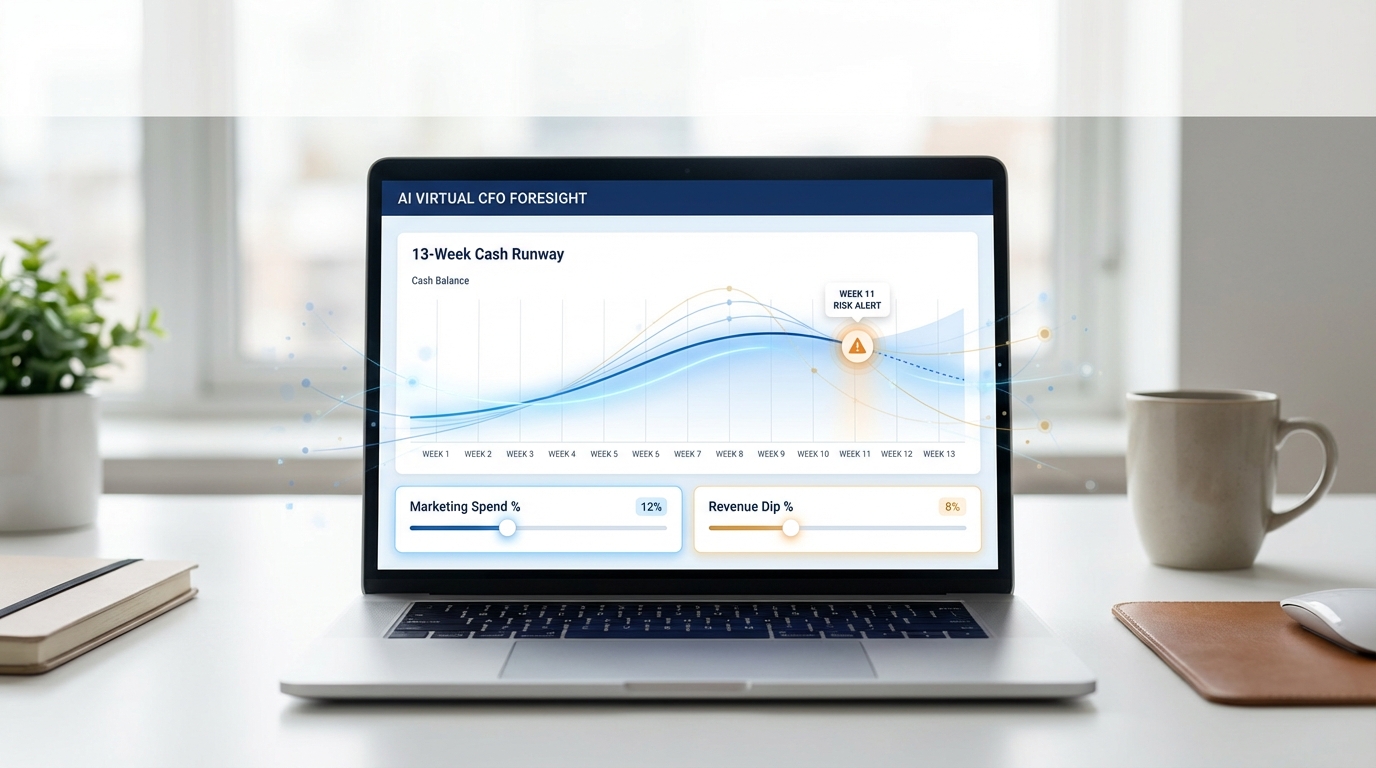
The Friday Afternoon Panic: Why Your Static Financial Model is a Liability
You are flying a rocket ship while staring at the rearview mirror. It's time to talk about the dangerous gap between "Accounting" and actual survival.
The 4:30 PM Alert
Let’s set a scene that will feel uncomfortably familiar to most Series A or B founders. It’s Friday at 4:30 PM. You are mentally checkout out, looking forward to a weekend where you might actually turn your phone off for two hours.
Then, an email notification slides onto your screen. It’s from your lead investor, who sits on your board.
"Hey Sarah, just looking at the Q1 projections vs. current hiring velocity. Are we absolutely sure about that 18-month runway figure given the spike in ad spend last week? Let's discuss first thing Monday."
Your stomach drops. The relaxing weekend evaporates. You know that 18-month figure was calculated three weeks ago, based on data that was already a month old when you received it.
You ping your part-time fractional CFO on Slack. No response; it's Friday afternoon. You are on your own. You open the shared drive and navigate to a file named something terrifying like Master_Financial_Model_v89_FINAL_REALLYFINAL.xlsx.
It takes 30 seconds just to load. Tabs upon tabs of hardcoded assumptions, broken reference links, and pivot tables that nobody on your current team knows how to fix. You stare at the "Cash Flow" tab. The numbers look neat, organized, and totally disconnected from the reality of what happened in your Stripe account this morning.
This is the ground-level reality for high-growth founders. You are expected to make hundred-thousand-dollar decisions instantly, but your financial intelligence is trapped in a brittle, static spreadsheet that is almost always obsolete.
Flying Blind at 200 MPH
Founders are builders, visionaries, and product leaders. You are not an accountant, nor should you be. Your job is to look forward, see the market gap, and accelerate towards it.
But to accelerate safely, you need a dashboard that tells you your current speed, fuel levels, and engine temperature in real-time. Instead, most startups are operating with a financial dashboard that takes snapshots every 30 days and mails them to you three weeks later.
You are driving a Formula 1 car at 200 MPH, but you are steering by looking exclusively at the rearview mirror. You know exactly where the road was last month, but you have zero visibility on the hairpin turn approaching tomorrow.
As a result, you make decisions based on gut instinct, proxy metrics (like user signups), or sheer optimism. Sometimes it works. But as your burn rate increases and your team grows, the margin for error shrinks to zero. One wrong assumption in that static spreadsheet about your Customer Acquisition Cost (CAC) can hide a six-figure cash hole until it’s too late to fix it without painful cuts.
The Villain: Your Brittle Spreadsheet
The Excel model that got you through your Seed round is now your biggest liability. It’s not just annoying; it’s dangerous. Why does the traditional spreadsheet model fail scaling startups?
- It’s Disconnected from Reality: Your spreadsheet does not talk to your bank account, your Stripe feed, your Gusto payroll, or your HubSpot CRM. It relies on a human being (usually an expensive one) to manually download CSVs, clean the data, and paste it into the right cells. This creates a massive lag between an event happening (cash leaving the bank) and you seeing it (the report next month).
- It’s Brittle and Fragile: That 50-tab workbook is a house of cards. A single "fat finger" error in a formula can compound across sheets, silently distorting your runway forecast by months. Change one core assumption—like shifting a product launch by two weeks—and the entire model often breaks, requiring hours of forensic accounting to fix.
- It Cannot Handle "What If": The market changes daily. You need to know: "What if we hire 3 sales reps today instead of next month?" or "What if our churn increases by 2%?" A static spreadsheet cannot answer these questions in real-time. It requires saving a new version, manually tweaking dozens of inputs, and hoping you didn't miss a dependency. By the time you have the answer, the opportunity has passed.
The Crucial Shift: Hindsight vs. Foresight
Before we can fix this, we have to understand the fundamental difference between two concepts that founders often confuse: Accounting and FP&A.
Accounting = Hindsight (Compliance)
Your bookkeeper and your CPA handle accounting. This is vital hygiene. It’s about categorizing transactions that already happened to ensure you pay your taxes and don't go to jail. It is, by definition, backward-looking. Your P&L statement tells you history.
FP&A = Foresight (Survival)
Financial Planning & Analysis (FP&A) is about survival. It takes the history from accounting, combines it with current operational data, and models the future. It answers the question: "Given what happened 10 minutes ago, do we have enough cash to survive until the next round?"
Most startups have excellent bookkeeping but zero true FP&A capability. They have spotless records of the past, but they are flying completely blind into the future.
The painful truth is that you cannot build a billion-dollar company using a bookkeeping workflow. You need a financial operating system that moves as fast as your engineering team.
The New Paradigm: A Dynamic Financial Engine
If a static spreadsheet is a rearview mirror, an AI-driven financial engine is a heads-up display (HUD) projected onto your windshield. It shows you the road ahead in real-time.
This isn't about buying a fancy new SaaS tool. It’s about a fundamental shift in your financial operations architecture. Instead of relying on manual data entry, we build pipelines that connect directly to the source of truth: your bank accounts, Stripe, Gusto, QuickBooks, and CRM.
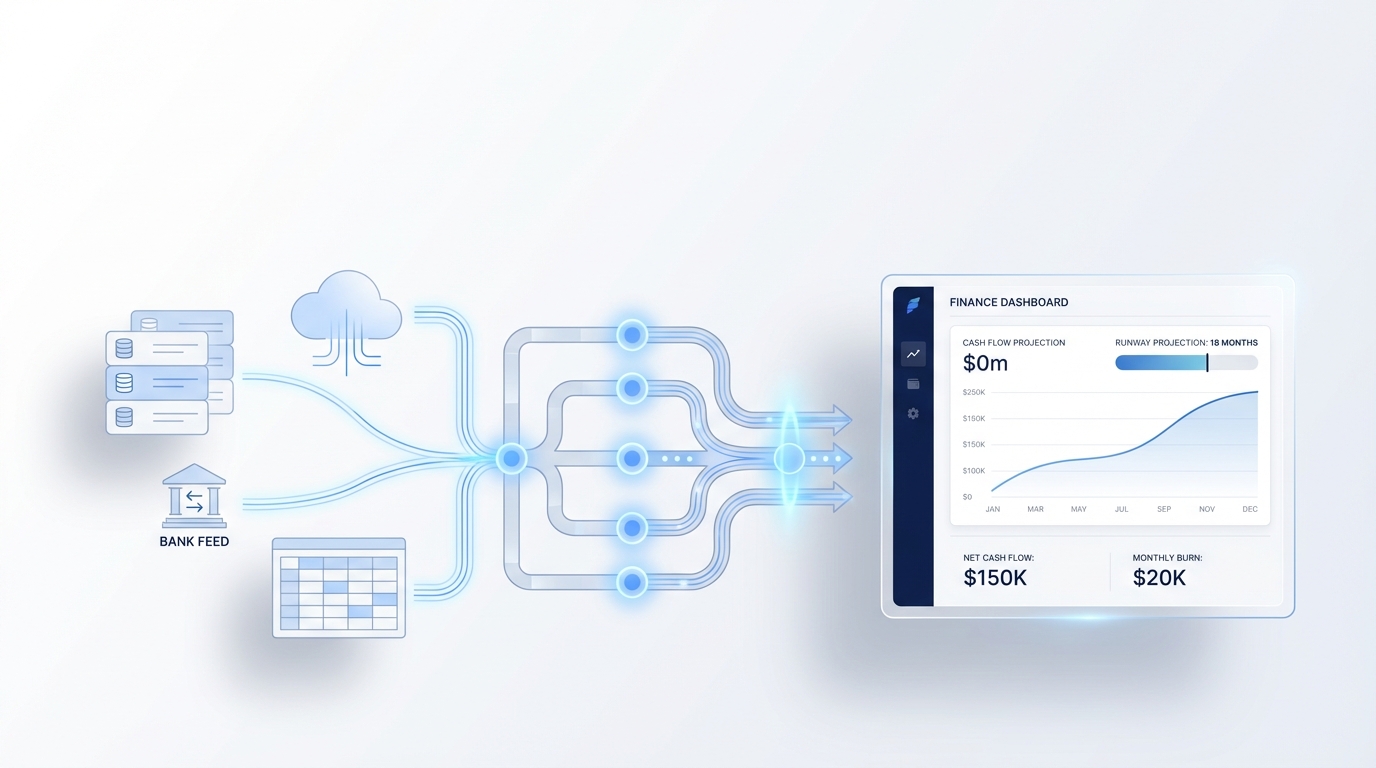
Using Python data frames and AI-assisted cleaning, raw transactional data is transformed instantly into finance-ready insights. The model is always "live." It doesn't wait for the month to close; it knows what happened five minutes ago.
Ground-Level Insight 1: The Power of Instant "What If"
Let’s go back to that Friday afternoon panic. The board is asking about runway. In the old world, answering that required three days of intense spreadsheet surgery. In the new paradigm, it happens in a 10-minute meeting.
Because the data is live and the model is dynamic, your Virtual CFO can run complex simulations on the fly during a strategy call.
The Scenario Dilemma: You have $2M in the bank. Your VP of Sales wants to hire 5 reps immediately. Your CMO wants to double ad spend next month. You can't do both.
- Simulation A (Aggressive Hiring): The model instantly calculates the impact of 5 new salaries, recruitment fees, and ramp-up time on your burn rate. Result: Runway drops to 9 months.
- Simulation B (Aggressive Marketing): The model simulates doubling ad spend, adjusting CAC assumptions based on recent trends, and projecting the resulting revenue lag. Result: Runway drops to 11 months, but with higher potential ARR growth.

You aren't guessing. You are making a strategic trade-off based on immediate visibility into the future impact of today's decisions.
Ground-Level Insight 2: The 13-Week Truth
GAAP accounting is necessary, but it can lie to you about survival. You can recognize $100k in revenue today, but if the client has Net-60 terms, that cash isn't paying salaries tomorrow.
The only truth that matters for near-term survival is the 13-Week rolling cash forecast. It is the operational heartbeat of a scaling startup.
Our AI-enhanced systems monitor historical payment patterns to predict exactly *when* cash will land, not just when it was invoiced. It flags anomalies—like a major customer paying 5 days later than usual—before it becomes a crisis.
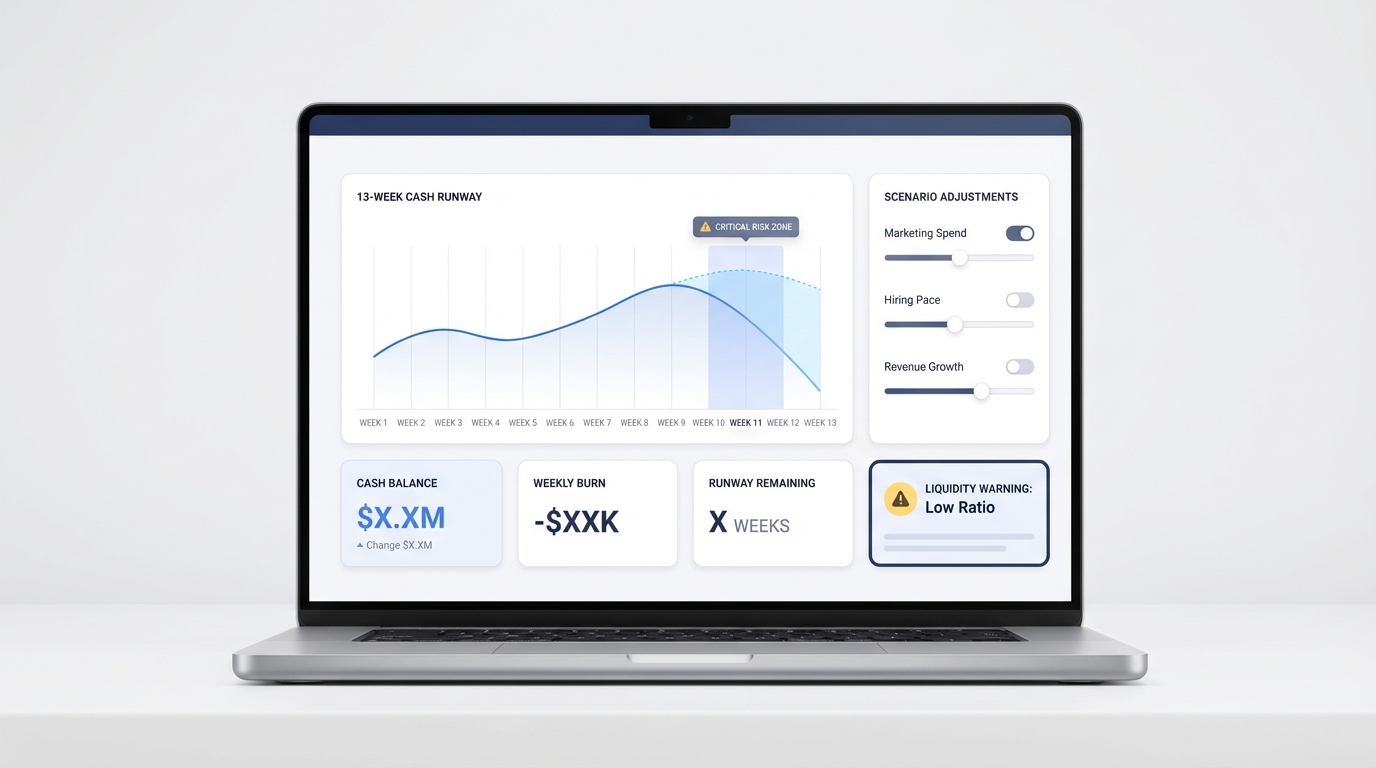
This dashboard doesn't just sit there. It alerts you. "Warning: Based on current AR aging and the new hiring plan, cash reserves dip below the safe threshold in Week 9." You now have 9 weeks to fix a problem you wouldn't have otherwise seen for a month.
The Synergy: Human Expertise Amplified by AI
A common fear is that AI is here to replace the CFO. The opposite is true. AI replaces the drudgery of finance.
In the old world, your expensive finance hire spent 80% of their time cleaning data in Excel and 20% on strategy. In the new paradigm, AI handles the 80%—the data piping, the categorization, the anomaly detection.
This frees up your Virtual CFO to spend 100% of their time acting as your strategic partner. They aren't staring at rows of data; they are interpreting the "heads-up display" and helping you navigate the race.
Conclusion: Upgrading Your Operating System
When that Friday afternoon email arrives from the board, you shouldn't feel panic. You should feel prepared.
Moving from static spreadsheets to AI-driven foresight isn't just about getting better reports. It’s about upgrading the operating system of your entire company to match the speed at which you need to make decisions. Stop driving with the rearview mirror and start seeing the curves ahead.

Founder of VextaCFO. Helping founders escape spreadsheet hell with real-time financial foresight and CFO-grade strategy.